I missed watching the short-lived show Firefly when it was on TV. I caught a handful of episodes, but it seemed jumbled - later I found out Fox showed the episodes out of order. Also, they didn't air the pilot episode first, and that was important for the setting and plot.
But, via Netflix, I was able to queue and watch the series. It doesn't take long, since there were only 14 episodes!
The show was really good, a different spin on sci-fi. Some of the crew had fought on the losing side of an independence war, and were making their living at the edge of the control of the authorities (the Alliance), doing whatever work they could find. Not all of it was strictly legal - lots of smuggling and robbery - but you could describe the crew as honorable thieves.
The pilot started with Simon, booking off-planet passage for him and his cargo... and the nature of the cargo required discretion. He could pay, and not many more questions were asked, so captain Malcolm of the ship Serenity took them on, and they departed.
As it turns out, the Simon's cargo was his sister River, whom he just busted out of a fancy Alliance military facility. Since they were wanted fugutives, this compounded the difficulty of finding work for the crew. Throughout the shows, bits and pieces of various characters were revealed, including a little background on Simon and River. She was taken away and enrolled in some Alliance military training/experimentation program, and had some extensive psychological programming that left her a little unbalanced.
Anyway, the movie begins with more background - we see Simon busting River out, and the reason why the Alliance is chasing after them so intently: she is also psychic. While captive, the doctors showed her off to various officials, and she read their minds and learned state secrets. Back on Serenity, the crew leaves for a holdup - they plan to steal the payroll from an Alliance security contractor, because they need money for repairs and food. Midway through the holdup, Reavers attack and then the plot bounces around as they hide from the Alliance and the assassin they send, to seeking answers to River's condition on a mysterious planet.
I think somebody could enjoy this movie without seeing the TV series, but the series would help in understanding some of the characters they reunite with: Inara, Shepherd Book, and the Reavers, who were inadvertently created by Alliance terraformers.
Since this was written by Joss Whedon, there is a Buffy moment or two: River is a carefully programmed killing machine, and in one fight scene where she mows down Reavers (who are basically not human anymore), I was thinking of Buffy the Vampire Slayer versus demons. But hey, that isn't bad. :)
Friday, September 30, 2005

Wednesday, September 28, 2005
The Amazing Race, Family Edition
It's back, a new season of my favorite reality show, The Amazing Race. This time, the teams are 4 people from the same family. Last night, I dozed off midway through the show so I watched the rest this morning.
The show started in Manhattan, proceeded to Pennsylvania and onto a family farm. It seems to me, and I might not be recalling correctly, but every other show whisked the contestants to a foreign country immediately. I'm curious how much foreign travel they'll make the families do this season. Maybe they are going easy since the teams are larger and some have kids along.
One team that really bugs me is the Paolo family - the are always bickering and rude to each other; I hope they are eliminated soon. The Linz family had a few supremely confident men who opted for the physical buggy ride challenge instead of the miniature house building. So it was quite funny to see them humbled by the difficulty and barely make it out of this round. It was a real bummer to see them edge out the Black family.
I'll cheer for the Gaghan family, since they are marathon runners. According to their mom, the 9 year old Carissa can run a 7 minute mile. Well dang, if she can hold that for a 5K she'd smoke me.
The show started in Manhattan, proceeded to Pennsylvania and onto a family farm. It seems to me, and I might not be recalling correctly, but every other show whisked the contestants to a foreign country immediately. I'm curious how much foreign travel they'll make the families do this season. Maybe they are going easy since the teams are larger and some have kids along.
One team that really bugs me is the Paolo family - the are always bickering and rude to each other; I hope they are eliminated soon. The Linz family had a few supremely confident men who opted for the physical buggy ride challenge instead of the miniature house building. So it was quite funny to see them humbled by the difficulty and barely make it out of this round. It was a real bummer to see them edge out the Black family.
I'll cheer for the Gaghan family, since they are marathon runners. According to their mom, the 9 year old Carissa can run a 7 minute mile. Well dang, if she can hold that for a 5K she'd smoke me.
Saturday, September 24, 2005
Autumn Rock 'n Run 5K
I showed up early to volunteer at registration, so I had plenty of time to get my packet, take it back to my car, and get set.
My goal was to take a few seconds off my previous 5K PR, and if things were to go really well, come in under 23 minutes. Results were already posted by the time I got back from breakfast. I managed to beat my goal on chip time, 22:52 or a 7:21.4 min/mi pace! If I can shave just a few more seconds off I can dream about a 45 minute 10K... next season. My only running goal this year is to do 1:45 at the half marathon coming up in December.
Anyway, my HRM/footpod absolutely nailed the distance. According to the watch, I covered 3.10 miles. Yes... accurate to the 1/100th of a mile! I know the footpod has accelerometers to account for pacing; I wonder if the accuracy varies by pace, because it wasn't that accurate on a slower training run. Or maybe the GPS was off instead. ;)
I set my HRM to take a split every mile, and the results were:
I forgot about this and didn't hear my watch beep until the 3rd mile, when I passed a volunteer calling out times right as the watch beeped to signal it took a split.
More data for my inner number cruncher. :) The times makes sense - mile 2 was fastest because I spent some time in mile 1 weaving around slower runners, and I was getting tired in mile 3.
After the race, I met some coworkers for breakfast. They have a tradition called "credit card karma", where everybody puts in their credit card, and the waiter chooses a random one who then picks up the bill. There were 5 of us, so good odds, and I wound up having a free breakfast. Right as they were leaving, some people from the Orlando Runner's Club showed up, so I sat with them and chatted a bit. Several members did a marathon in France that sounded more like an extended wine tasting trip - wine was featured at every aid station. I think that would seriously hamper my chances of finishing such an event!
My goal was to take a few seconds off my previous 5K PR, and if things were to go really well, come in under 23 minutes. Results were already posted by the time I got back from breakfast. I managed to beat my goal on chip time, 22:52 or a 7:21.4 min/mi pace! If I can shave just a few more seconds off I can dream about a 45 minute 10K... next season. My only running goal this year is to do 1:45 at the half marathon coming up in December.
Anyway, my HRM/footpod absolutely nailed the distance. According to the watch, I covered 3.10 miles. Yes... accurate to the 1/100th of a mile! I know the footpod has accelerometers to account for pacing; I wonder if the accuracy varies by pace, because it wasn't that accurate on a slower training run. Or maybe the GPS was off instead. ;)
I set my HRM to take a split every mile, and the results were:
- Mile 1 - 7:20.5
- Mile 2 - 7:09.9
- Mile 3 - 7:35.9
- 0.1 mile - 0:49
I forgot about this and didn't hear my watch beep until the 3rd mile, when I passed a volunteer calling out times right as the watch beeped to signal it took a split.
More data for my inner number cruncher. :) The times makes sense - mile 2 was fastest because I spent some time in mile 1 weaving around slower runners, and I was getting tired in mile 3.
After the race, I met some coworkers for breakfast. They have a tradition called "credit card karma", where everybody puts in their credit card, and the waiter chooses a random one who then picks up the bill. There were 5 of us, so good odds, and I wound up having a free breakfast. Right as they were leaving, some people from the Orlando Runner's Club showed up, so I sat with them and chatted a bit. Several members did a marathon in France that sounded more like an extended wine tasting trip - wine was featured at every aid station. I think that would seriously hamper my chances of finishing such an event!
Moneyball
I'm not the biggest baseball fan, but this book intrigued me. Moneyball is the story of how thee 2002 Oakland A's were competitive, despite having a very low payroll.
The answer was through statistical analysis - the team's management found certain traits were valued incorrectly by the market. For example, batters who hit lots of home runs typically command a premium. However, what is more important is the guy who reliably singles or draws walks. Similarly, pitchers were often rated by their earned run average, but what is more important is the ratio of strikes to walks. A statistical analysis showed the ERA is basically utterly random - it is theorized a pitcher doesn't actually control this at all, it is more what the fielders are doing.
Another interesting point was evaluating position players on their number of errors. The error is unique in sports, since it is a play scored by what some else (the official scorer) thinks should have happened. The A's management at the time felt that a guy who had an error at least did one thing right: he was where the ball was. Whereas, the guy who never had any errors might be like that because he reacted too slow or couldn't run fast enough.
Even more interesting were formulas they developed to predict how many runs were needed to win a certain percentage of games, and in turn figure out how to form a team to get the right number of runs.
I'm a so-so baseball fan, but I found this book a very interesting mix of sports, statistics, and economic analysis focused on evaluating talent and picking up bargain players. Now that the A's secret is out, I wonder if the market has changed out from under them? Or, how have they done since 2002?
The answer was through statistical analysis - the team's management found certain traits were valued incorrectly by the market. For example, batters who hit lots of home runs typically command a premium. However, what is more important is the guy who reliably singles or draws walks. Similarly, pitchers were often rated by their earned run average, but what is more important is the ratio of strikes to walks. A statistical analysis showed the ERA is basically utterly random - it is theorized a pitcher doesn't actually control this at all, it is more what the fielders are doing.
Another interesting point was evaluating position players on their number of errors. The error is unique in sports, since it is a play scored by what some else (the official scorer) thinks should have happened. The A's management at the time felt that a guy who had an error at least did one thing right: he was where the ball was. Whereas, the guy who never had any errors might be like that because he reacted too slow or couldn't run fast enough.
Even more interesting were formulas they developed to predict how many runs were needed to win a certain percentage of games, and in turn figure out how to form a team to get the right number of runs.
I'm a so-so baseball fan, but I found this book a very interesting mix of sports, statistics, and economic analysis focused on evaluating talent and picking up bargain players. Now that the A's secret is out, I wonder if the market has changed out from under them? Or, how have they done since 2002?
Wednesday, September 21, 2005
Mandarin Class
I'm only fluent in English, and have made various efforts (some half-hearted) at learning Spanish and Japanese. Spanish barely counts since that was in high school at the time and I put no work into it. Japanese came along later when I was an adult and became far more interested in learning a foreign language.
After the second Mandarin class (I missed last week due to the LA trip), I notice that Mandarin feels a lot different. I mean that my jaw, lips, and mouth feel like they are moving in strange ways (compared to English, Spanish, and Japanese) just trying to get the pronounciation correct. But it is very interesting.
The class itself is OK, it is somewhere between just a conversational class (i.e. let's memorize these two dozen phrases) and a full language class (i.e. where study include grammar). Pinyin is still very difficult, because I see the letters and have to fight an ingrained English pronunciation that instantly comes to mind. In that respect the Japanese hiragana and katakana is easier to deal with, but then pronunciation in Japanese is a lot easier than Mandarin anyway, even when romanized.
After the second Mandarin class (I missed last week due to the LA trip), I notice that Mandarin feels a lot different. I mean that my jaw, lips, and mouth feel like they are moving in strange ways (compared to English, Spanish, and Japanese) just trying to get the pronounciation correct. But it is very interesting.
The class itself is OK, it is somewhere between just a conversational class (i.e. let's memorize these two dozen phrases) and a full language class (i.e. where study include grammar). Pinyin is still very difficult, because I see the letters and have to fight an ingrained English pronunciation that instantly comes to mind. In that respect the Japanese hiragana and katakana is easier to deal with, but then pronunciation in Japanese is a lot easier than Mandarin anyway, even when romanized.
Saturday, September 17, 2005
My New Bike
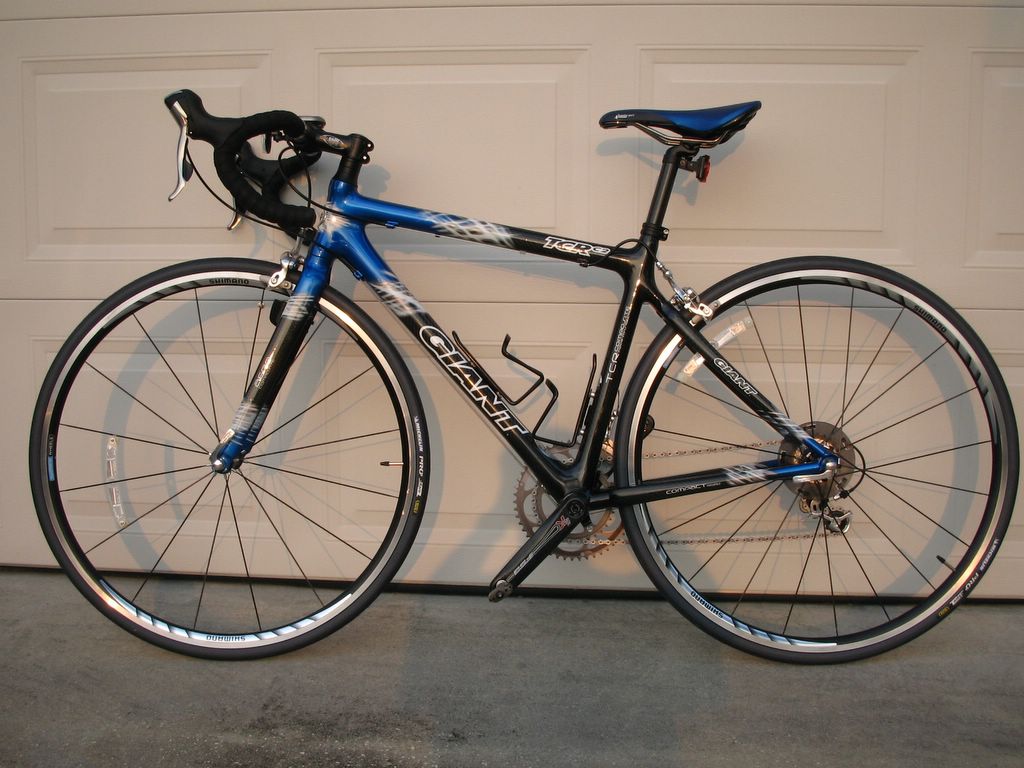
Yes, I just can't stop buying bikes. ;) Here it is, my newest one, a Giant TCR Composite 2, with Speedplay X/2 pedals, and FSA Compact Cranks (50/34) with an Ultegra 10 speed 11/23 cassette. I'll ride it around for a while before adding aerobars.
This bike is the reward to myself for IMCdA. :) It upgrades my trusty Trek 2000, which has carried me through lots of events, training, and rides in general.
My New Bike
I decided to go with the compact cranks because the 50/34 matched with an 11/23 gives better high and low gear ratios than the traditional 53/39 and 12/25. Read all about it here. Basically, the 53/39 is wildly overgeared for me, yet a triple chainring seems like overkill here in Florida. I do like the triple but one thing that bugs me is the shifting is always a bit off - the chain rubs on the front derailleur more often - just due to the how far the derailleur has to travel.
Now that I have four bikes, I plan to switch a few things around in the upcoming months. Long term, I want to trade in my Cervelo towards a Litespeed - a Tuscany or perhaps a Saber, I'm not sure. It depends on if I want a specific tri-geometry bike, and if I do, perhaps I'd go crazy and get something like a Guru Chrono, since those can be custom tweaked as far as my specific measurements. In the meantime, it is still a good bike and I'll make use of it, but the lure of titanium might be hard to resist. ;) I find myself riding more and more in road groups and thus a road bike is more useful and safe, so I'm moving towards having road bikes, possibly with clip-on aerobars. Even at a tri I don't spend a huge amount of time in the aerobars.
As for the Trek 2000 and Trek 1000 I have - I'll keep one as a power crank bike, and send the other to my parents, so I have something to do when I visit. Who knows, someday I might sign up for a Dallas-area tri and not feel like shipping a bike. I haven't decided whether to make the Trek 2000 the new power crank bike (and thus ship the Trek 1000), or keep the Trek 1000 as the power crank bike (and thus ship off the Trek 2000). The Trek 2000 has nicer components (I had it upgraded to Ultegra) so it might be a waste to put power cranks on it. On the other hand, it might be a waste to be in semi-retirement at my parents. But, the Giant is replacing the Trek 2000, so it won't get much riding from here on out anyway. What might be the deciding factor is that I bought the Trek 1000 locally, and the store I bought it from offers some kind of discount on service.
Or I could keep all of them here. I think of Francesca and her "rain" bike, which also serves as a trainer bike. The thing is here, the concept of "rain" bike is lost, because when it rains, it rains heavily, often with lightning. As a cyclist in the pacific northwest, you had to be willing to ride in a bit of rain. If you could tolerate a minor drizzle, that would greatly increase the number of days you were riding. Here, there isn't really a point to a specific bike for lousy conditions, since when it is lousy, you don't want to be riding anyway.
I'm leaning towards shipping off the Trek 2000... maybe I'll throw it a party and clean it really well before sending it to a new life. ;)
This bike is the reward to myself for IMCdA. :) It upgrades my trusty Trek 2000, which has carried me through lots of events, training, and rides in general.
My New Bike
I decided to go with the compact cranks because the 50/34 matched with an 11/23 gives better high and low gear ratios than the traditional 53/39 and 12/25. Read all about it here. Basically, the 53/39 is wildly overgeared for me, yet a triple chainring seems like overkill here in Florida. I do like the triple but one thing that bugs me is the shifting is always a bit off - the chain rubs on the front derailleur more often - just due to the how far the derailleur has to travel.
Now that I have four bikes, I plan to switch a few things around in the upcoming months. Long term, I want to trade in my Cervelo towards a Litespeed - a Tuscany or perhaps a Saber, I'm not sure. It depends on if I want a specific tri-geometry bike, and if I do, perhaps I'd go crazy and get something like a Guru Chrono, since those can be custom tweaked as far as my specific measurements. In the meantime, it is still a good bike and I'll make use of it, but the lure of titanium might be hard to resist. ;) I find myself riding more and more in road groups and thus a road bike is more useful and safe, so I'm moving towards having road bikes, possibly with clip-on aerobars. Even at a tri I don't spend a huge amount of time in the aerobars.
As for the Trek 2000 and Trek 1000 I have - I'll keep one as a power crank bike, and send the other to my parents, so I have something to do when I visit. Who knows, someday I might sign up for a Dallas-area tri and not feel like shipping a bike. I haven't decided whether to make the Trek 2000 the new power crank bike (and thus ship the Trek 1000), or keep the Trek 1000 as the power crank bike (and thus ship off the Trek 2000). The Trek 2000 has nicer components (I had it upgraded to Ultegra) so it might be a waste to put power cranks on it. On the other hand, it might be a waste to be in semi-retirement at my parents. But, the Giant is replacing the Trek 2000, so it won't get much riding from here on out anyway. What might be the deciding factor is that I bought the Trek 1000 locally, and the store I bought it from offers some kind of discount on service.
Or I could keep all of them here. I think of Francesca and her "rain" bike, which also serves as a trainer bike. The thing is here, the concept of "rain" bike is lost, because when it rains, it rains heavily, often with lightning. As a cyclist in the pacific northwest, you had to be willing to ride in a bit of rain. If you could tolerate a minor drizzle, that would greatly increase the number of days you were riding. Here, there isn't really a point to a specific bike for lousy conditions, since when it is lousy, you don't want to be riding anyway.
I'm leaning towards shipping off the Trek 2000... maybe I'll throw it a party and clean it really well before sending it to a new life. ;)
Friday, September 16, 2005
PDC Wrap Up
The best sessions I attended were on the last two days of the conference: a talk on Win32 programming, Under the Hood of Vista/Longhorn, future plans for C#, future plans for C++, and garbage collection in .NET. So, maybe in the future if I go I'll arrange to just hit the last half. ;)
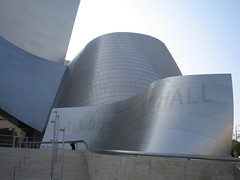
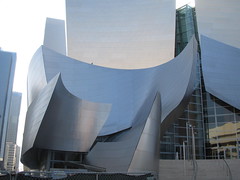
I had a few hours free on Friday, so I walked from the hotel to Walt Disney Hall. This is probably the one thing in the area that has the name Disney on it, that wouldn't appearl to kids - it is the new symphony hall. It is pretty cool looking, all brushed-metallic and curvy, similar to the EMP in Seattle except not as garish and well, better looking.
On one side of the hall is a small park, raised above the sidewalk, with a nice view of the city. The centerpiece of the park is a flower petal fountain, made from crushed marble. There were shady spots and tables and chairs, so I took the opportunity to read a few pages of The Botany of Desire, which I've been making slow but steady progress in. I was in the tulip chapter, reading about the beauty of flowers, so I decided to take a few macro closeups of ones right next to me.
After a while I got up and followed a hidden exterior path which wound up near the roof of the building. At one point the roof structure was exposed and you could see the support beams and how the metal sheets were hung on them. Plus of course, more views of downtown. Unfortunately it was too late to take a tour of the interior, so I left and went to the Westin Bonaventure for dinner.
That hotel has been the shooting location for at least two movies, because of its dramatic exterior elevators: In the Line of Fire, and True Lies. Near the elevator shafts are plaques which point this fact out! I wandered around the open air six story atrium, full of shops and restaurants, and settled in on an expensive sushi dinner (good thing I can expense it!).
I had a few hours free on Friday, so I walked from the hotel to Walt Disney Hall. This is probably the one thing in the area that has the name Disney on it, that wouldn't appearl to kids - it is the new symphony hall. It is pretty cool looking, all brushed-metallic and curvy, similar to the EMP in Seattle except not as garish and well, better looking.
On one side of the hall is a small park, raised above the sidewalk, with a nice view of the city. The centerpiece of the park is a flower petal fountain, made from crushed marble. There were shady spots and tables and chairs, so I took the opportunity to read a few pages of The Botany of Desire, which I've been making slow but steady progress in. I was in the tulip chapter, reading about the beauty of flowers, so I decided to take a few macro closeups of ones right next to me.
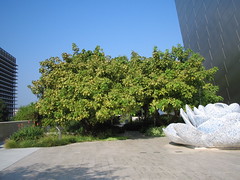

After a while I got up and followed a hidden exterior path which wound up near the roof of the building. At one point the roof structure was exposed and you could see the support beams and how the metal sheets were hung on them. Plus of course, more views of downtown. Unfortunately it was too late to take a tour of the interior, so I left and went to the Westin Bonaventure for dinner.
That hotel has been the shooting location for at least two movies, because of its dramatic exterior elevators: In the Line of Fire, and True Lies. Near the elevator shafts are plaques which point this fact out! I wandered around the open air six story atrium, full of shops and restaurants, and settled in on an expensive sushi dinner (good thing I can expense it!).
Subscribe to:
Posts (Atom)