OK I've been a slacker with the blog. But, I wrote three more entries about my Japan trip and am resolved to finish up the rest by next week. I've been busy with the usual... and a heavy dose of running.
I returned from the trip determined to pick up and emphasize my running. It was so exciting to travel there and also meet a bunch of other people sharing an interest. Plus, I would like to do a marathon later in the year, and finish in a decent time, so I signed up for Marathonfest, a local training program. The program includes Tuesday track workouts, Thursday tempo runs, and Saturday morning runs.
I'll attend as many Tuesday track sessions as I can, but probably skip the Thursday tempo run in favor of staying local in Lake Mary and running with the Y group. The Saturday morning long run is the cornerstone of the program, and something I haven't been doing on my own. Or done for quite a while.
What is tough is how early that long run is - meet at 5:45 AM (or earlier!) and leave at 6:00 AM. Harsh but necessary.
So it was tough getting up at 4:45 AM for the first long run I could make. I was still groggy pulling into the park, but was happy to see about 40-50 other people also up at this crazy hour. Others tell me this spring session is half the size of the fall session! The group has critical mass, whereby you could search around a bit and find other people wanting to run your pace and desired distance. Or you could just run the day's workout with your own pace group. I wound up running with 3 or 4 others, an out-and-back in Winter Park for 7.9 miles in 1:06, for an 8:25 pace.
The next workout was short for me - I signed up for a 5K, so I just ran a warmup of 3.9 miles, out-and-back to the first water stop. Following this I did the House of Hope 5K in about 22:40, which I am very happy with since I haven't been doing much speed work.
Saturday, February 23, 2008

Monday, February 11, 2008
Japan Trip
I'm back from a fantastic trip, and still sorting pictures and thinking of what to write. So I'll be filling this in during the upcoming days. In the meantime, my trip outline:
Also, the Urayasu Runners Club kept a blog of "Orlando Week 2008".
- Jan 31 - Arrival
- Feb 1 - Lost Day
- Feb 2 - URC meeting
- Feb 2 - Imperial Palace
- Feb 3 - Race Day
- Feb 3 - Homestay
- Feb 3 - Welcome Party
- Feb 4 - Kamakura
- Feb 5 - Urayasu
- Feb 5 - Bullet Train to Kyoto
- Feb 6 - Kyoto Walking Tour
- Feb 7 - Ryokan
- Feb 8 - Wandering Around Tokyo
- Feb 9 - Tsukiji and Hamarikyu Park
- Feb 9 - Onsen
- Feb 10 - Tokyo Tower
- Feb 10 - Departure
Also, the Urayasu Runners Club kept a blog of "Orlando Week 2008".
Wednesday, February 06, 2008
Kyoto Walking Tour
I found a nice walking tour of Kyoto and followed it.
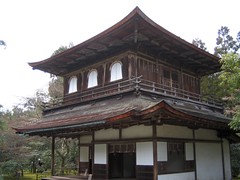
Temple of the Silver Pavillion.
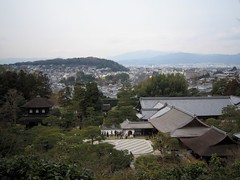
Kyoto view from the Ginkakuji grounds.
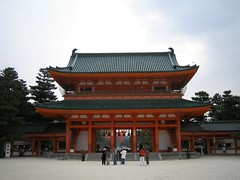
Heian Shrine
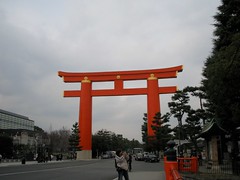
Torii Gate near the Heian Shrine, in Kyoto.
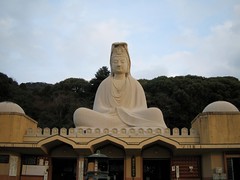
Ryozen Kannon
Nijō Castle.
This castle is famous for the "nightingale" floors... squeaky wooden floors that alerted the occupants if anybody was attempting to sneak up on them.
Kinkakuji, Temple of the Golden Pavillion.
This is Kyoto's most famous tourist attraction, a spectacular building. It was busy even in February, I imagine at the height of the tourist season it is difficult to get a clear view of the building!
Temple of the Silver Pavillion.
Kyoto view from the Ginkakuji grounds.
Heian Shrine
Torii Gate near the Heian Shrine, in Kyoto.
Ryozen Kannon
Nijō Castle.
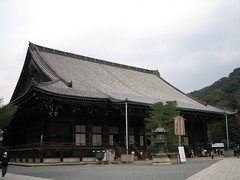
This castle is famous for the "nightingale" floors... squeaky wooden floors that alerted the occupants if anybody was attempting to sneak up on them.
Kinkakuji, Temple of the Golden Pavillion.
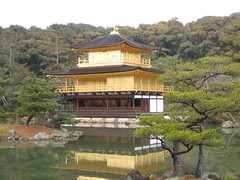
This is Kyoto's most famous tourist attraction, a spectacular building. It was busy even in February, I imagine at the height of the tourist season it is difficult to get a clear view of the building!
Tuesday, February 05, 2008
Bullet Train to Kyoto
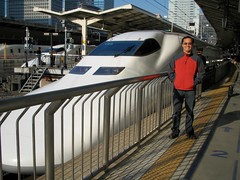
After touring Urayasu in the morning, I met up with the group to say bye. They were all flying back, but I took an extra 5 days off work to see more of Japan! I arranged a side trip for myself to Kyoto, and got there by taking the Shinkansen from Tokyo. Shige helped me buy the tickets and waited outside until the train left.
Standing in front of the Nozomi Shinkansen.
Standing in front of the Nozomi Shinkansen.
Urayasu
In the morning, Shige drove me around the old part of Urayasu. Most of the city is new, built on land reclaimed from the sea. Shige took me to the "old" town, where the streets were very narrow, and there was more evidence of the original industry of the area: fishing.
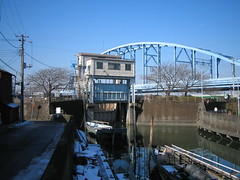
Urayasu is at sea level, and has a canal and watergate system used to control flooding. The gate opens and closes during high tide and low tide.
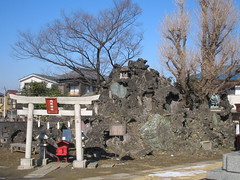
Urayasu has three shrines, and we visited one of them. This sculpted hill is on the side of the main building.
Shige said the proper way to pay respects is to clap your hands twice (with a large sweeping motion), pray, clap once more, and then toss some coins into the collection box. ;) Sometimes there is a bell to ring (attached to a rope). He demonstrated and then I did it.
While in Urayasu, we noticed these mats all over the place. What were they, and what was their purpose? They followed streets, forked at intersections, and switched patterns at obstacles like stairways. We took a few guesses but wound up asking our hosts.
They told us these mats were for blind people - the grooves helped guide their walking sticks. Very interesting!
After seeing the shrine, we drove over to the city museum, which had a nice display on the history and culture of Urayasu. It was also a popular spot for school kids as there were at least 3 or 4 classes of elementary school students in there as well! The museum had vintage pictures of the early industries (fishing and nori farming), some replica equipment such as boats and clamming gear, and a small model of what an original section of the city looked like.
For lunch, Shige took me to a nearby restaurant where we had some very delicious unagi.
Urayasu is at sea level, and has a canal and watergate system used to control flooding. The gate opens and closes during high tide and low tide.
Urayasu has three shrines, and we visited one of them. This sculpted hill is on the side of the main building.
Shige said the proper way to pay respects is to clap your hands twice (with a large sweeping motion), pray, clap once more, and then toss some coins into the collection box. ;) Sometimes there is a bell to ring (attached to a rope). He demonstrated and then I did it.

While in Urayasu, we noticed these mats all over the place. What were they, and what was their purpose? They followed streets, forked at intersections, and switched patterns at obstacles like stairways. We took a few guesses but wound up asking our hosts.
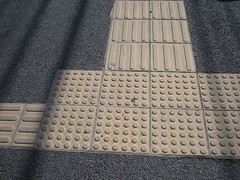
They told us these mats were for blind people - the grooves helped guide their walking sticks. Very interesting!
After seeing the shrine, we drove over to the city museum, which had a nice display on the history and culture of Urayasu. It was also a popular spot for school kids as there were at least 3 or 4 classes of elementary school students in there as well! The museum had vintage pictures of the early industries (fishing and nori farming), some replica equipment such as boats and clamming gear, and a small model of what an original section of the city looked like.
For lunch, Shige took me to a nearby restaurant where we had some very delicious unagi.
Monday, February 04, 2008
Kamakura
Several URC members took us to Kamakura, southeast of Tokyo right off a subway stop.
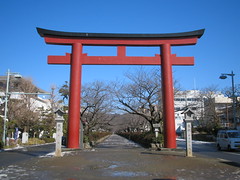
We headed towards the Tsurugaoka Hachiman shrine, at the end of a path that began with a torii. It looks like the path vanishes in the distance, but that is partly an optical illusion as it is built that way - the path narrows as it approaches the shrine.
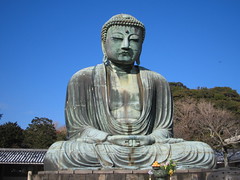
After lunch we walked back along a street lined with shops, and eventually caught a bus to see Daibutsu, the famous large statue of Buddha.
After that we visited Kenchō-ji, a large Zen temple nearby.
This peach blossom is a sign of spring. We told the Japanese our equivalent spring tradition is Groundhog Day, which they thought was amusing.
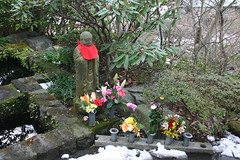
Kenchō-ji had a small cave accessible by tunnels. The tunnels were lined with various carvings. The cave had more carvings, and was a place people came to leave small statues and flowers as offerings.
We headed towards the Tsurugaoka Hachiman shrine, at the end of a path that began with a torii. It looks like the path vanishes in the distance, but that is partly an optical illusion as it is built that way - the path narrows as it approaches the shrine.
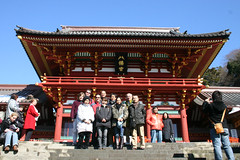
After lunch we walked back along a street lined with shops, and eventually caught a bus to see Daibutsu, the famous large statue of Buddha.
After that we visited Kenchō-ji, a large Zen temple nearby.
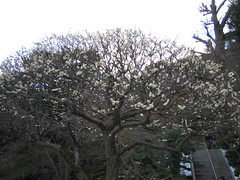
This peach blossom is a sign of spring. We told the Japanese our equivalent spring tradition is Groundhog Day, which they thought was amusing.
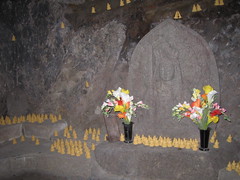
Kenchō-ji had a small cave accessible by tunnels. The tunnels were lined with various carvings. The cave had more carvings, and was a place people came to leave small statues and flowers as offerings.
Sunday, February 03, 2008
Homestay
The usual schedule for the exchange trip is to check out of our hotel after the race, and then have a homestay with a Japanese family until departure. My homestay was with the Yanagida family: Shigeyuki and Emiko. Shige and Emiko visited Orlando in December 2007 for the OUC half marathon, so I had met them before.
Like many densely populated urban areas, most people live in condos. Shige and Emiko's home was in a building near the subway stop (very convenient!) on the 17th floor. The building had an open-air central corridor with a trash room and elevator access, with 6 or 7 units on each floor.
Their home was immaculate, I think they both cleaned extensively prior to my arrival. The front door opened onto a small atrium with a closet, where visitors leave their shoes and swap for slippers. The kitchen, dining room, and living room were behind a door, the sink and bathroom were behind another door, and the hallway led to three bedrooms and a small room with the toilet. I had heard all sorts of stories about tiny living spaces in Tokyo - this home was larger than I expected, and on par with condos I've seen in other metropolitan areas.
Their view was amazing! It is a hazy day, but along the right edge of the picture, at the horizon, is Mt. Fuji.
The next morning, Emiko fixed me a traditional Japanese breakfast.
(Check out the image on flickr - I used the "add note" feature annotate items). Breakfast consisted of small portions of several foods: natto (fermented soy beans), fish, salad, spinach and eggs, carrots and noodles. The presentation made it look like artwork!
I can't post about a trip to Japan without mentioning the Japanese bath. The bathroom, even in the hotel, had a combined shower/tub room, except instead of the shower being in the tub, it was by the side. Also, the entire room was for bathing, so no shower curtain. By the shower head, which had a few fixed positions (low, medium, high), was a pail and stool to sit on. The idea was to soap and shower, sitting on the stool, rinse off, and then get in the bathtub for a relaxing post-shower soak. The tub had a lid over it, and was kept filled with hot (42 degrees Celsius) water. It is a nice way to wind down at the end of the day!
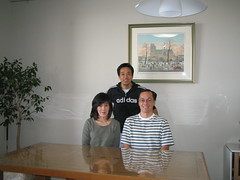
Like many densely populated urban areas, most people live in condos. Shige and Emiko's home was in a building near the subway stop (very convenient!) on the 17th floor. The building had an open-air central corridor with a trash room and elevator access, with 6 or 7 units on each floor.
Their home was immaculate, I think they both cleaned extensively prior to my arrival. The front door opened onto a small atrium with a closet, where visitors leave their shoes and swap for slippers. The kitchen, dining room, and living room were behind a door, the sink and bathroom were behind another door, and the hallway led to three bedrooms and a small room with the toilet. I had heard all sorts of stories about tiny living spaces in Tokyo - this home was larger than I expected, and on par with condos I've seen in other metropolitan areas.
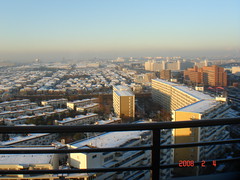
Their view was amazing! It is a hazy day, but along the right edge of the picture, at the horizon, is Mt. Fuji.
The next morning, Emiko fixed me a traditional Japanese breakfast.
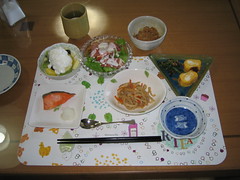
(Check out the image on flickr - I used the "add note" feature annotate items). Breakfast consisted of small portions of several foods: natto (fermented soy beans), fish, salad, spinach and eggs, carrots and noodles. The presentation made it look like artwork!
I can't post about a trip to Japan without mentioning the Japanese bath. The bathroom, even in the hotel, had a combined shower/tub room, except instead of the shower being in the tub, it was by the side. Also, the entire room was for bathing, so no shower curtain. By the shower head, which had a few fixed positions (low, medium, high), was a pail and stool to sit on. The idea was to soap and shower, sitting on the stool, rinse off, and then get in the bathtub for a relaxing post-shower soak. The tub had a lid over it, and was kept filled with hot (42 degrees Celsius) water. It is a nice way to wind down at the end of the day!
Subscribe to:
Posts (Atom)